vCongress
Scientific congress management with registration, abstracts, reviewing, payments, and workflows.
Registration · Abstracts · Reviewing · Program planning · Role models
Learn more about vCongressOpen vcongress.de
Platform development · SaaS · custom systems
SciSerTec builds specialized platforms, custom software solutions, and modern SaaS systems based on modular architecture and cloud design.
From specialized platforms to modular SaaS systems.
Scientific congress management with registration, abstracts, reviewing, payments, and workflows.
Registration · Abstracts · Reviewing · Program planning · Role models
Learn more about vCongressOpen vcongress.deTailored platforms for organizations whose core processes cannot be covered by standard software.
Administrative systems · Voting systems · Community platforms · E-commerce
Discuss custom developmentNew product platforms built on proven reusable architecture foundations.
Fast prototyping · Modular basis · Cloud-native design · Scalable growth
Discover platform conceptsModular architecture with focus on clarity, scalability, and long-term maintainability.
DDD · Modular systems · Cloud infrastructure · Serverless · Workflow engines
View technologyOver many years, SciSerTec built a reusable platform foundation across identity, roles, workflows, forms, administration, and cloud infrastructure. This enables faster delivery, stable operations, and better long-term maintainability.
Platform thinking over isolated one-off development.
Digital voting system with controlled permissions, secure workflows, and traceable results.
Custom e-commerce platform with product variants, checkout, payment integration, and admin backend.
Community platform for organizers and providers with profile, network, and discovery features.
A second product should not start at zero. Ours does not.
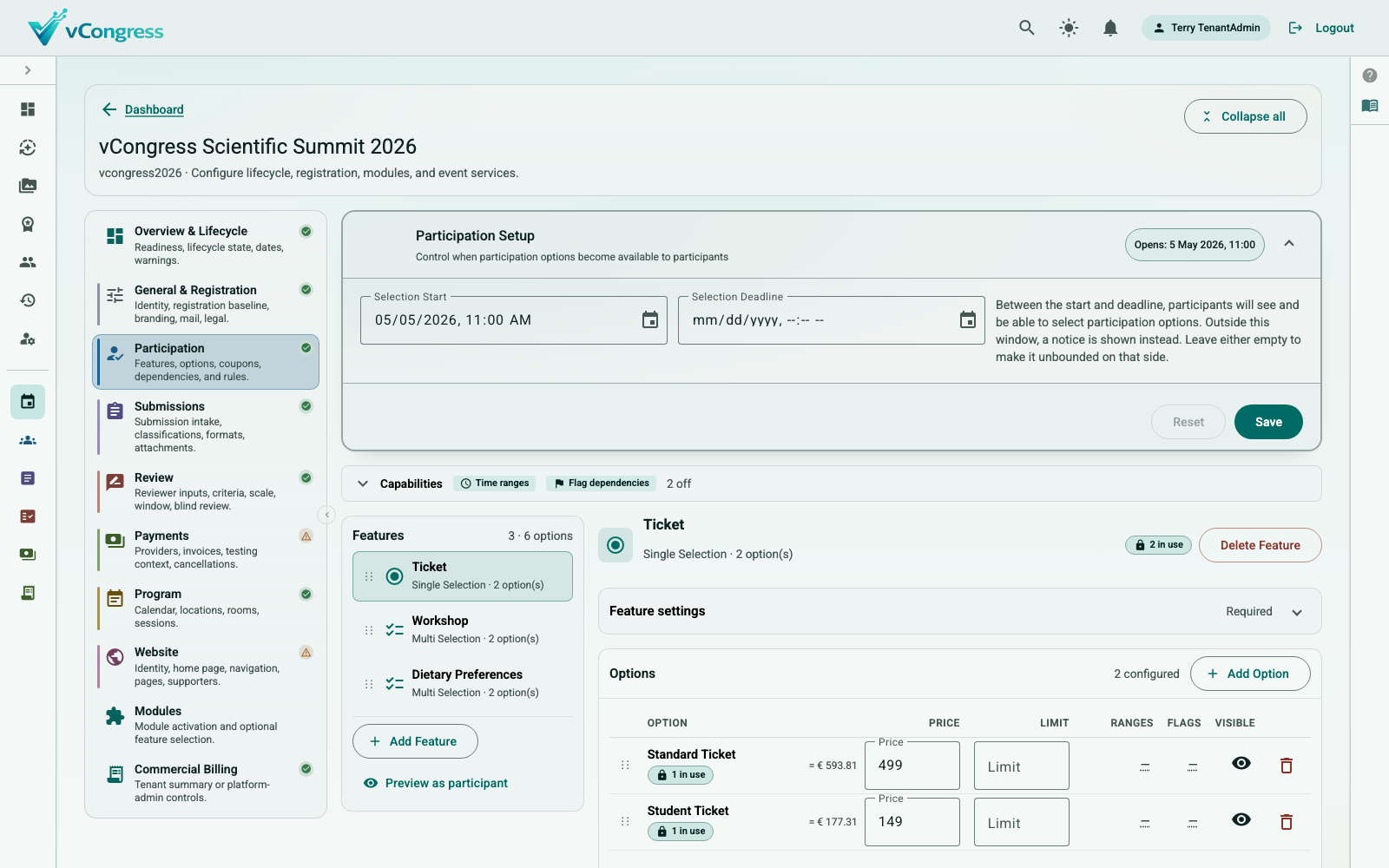
vCongress is not one program. It is a set of capabilities — registration, submission, review, scheduling, payment and invoicing, public presentation, notification — each declared in a registry, switched on per event, and licensed per organisation. Adding one is a catalog entry and its enforcement point, not a branch of the product. That is why a customer-specific requirement becomes part of the standard platform instead of a fork nobody can maintain two years later.
The same parts assemble differently for a different domain. A grant review process, a member directory, a clinical registry and a training programme all need identity, roles, structured submission, review, scheduling, billing and notification — and differ in the model on top, not the machinery underneath.
Clear domains and process boundaries as the product foundation — the part that genuinely differs between products.
Capabilities are declared once, entitled per customer, and activated per use. New ones attach; they do not branch.
Serverless and defined as code, so a second product inherits the operational baseline rather than rebuilding it.
Stepwise growth instead of risky full replacements — the reason vCongress is still evolving rather than being rewritten.
And if you want to own the product rather than use ours. Some organisations do not want to be a tenant on someone else's platform — they want their own product, for their own market. That is the same construction job with a different model on top. Multi-tenancy, identity, roles, single sign-on, passkeys, per-customer entitlement, media handling and an audit trail are already built and already operated, so the part designed from scratch is the part that is actually yours. We are open about the boundary too: the platform spine carries over, the domain model does not, and where a capability is still tied to congress operations we say so at the start rather than discovering it halfway through.
Where this is heading: assembling a new SaaS product largely from capabilities that already exist and are already operated. We are not claiming a finished product factory — we are saying the parts are built to combine, and one platform in production is the evidence.
Systems structured around business domains and real process logic.
Extendable platforms with clear responsibilities and stable interfaces.
Readable, maintainable software structures for long-lived systems.
Reliable runtime architecture for growth, security, and governance.